Contact us
 Visit CPRE.org
 Donate
Peak Cluster: key questions about energy infrastructure
We would like to reassure members that we are continuing to keep a careful watch on the Peak Cluster proposal and remain in contact with the developers, asking questions on behalf of our supporters and seeking further information about the scheme.
What is the Peak Cluster?
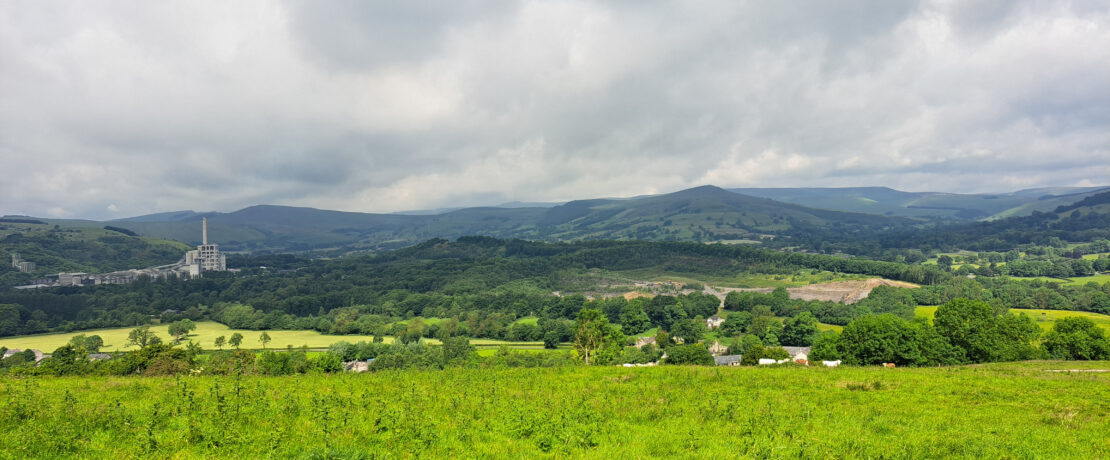
The Peak Cluster is a proposed carbon capture, transport and storage project developed in collaboration with cement and lime manufacturers – including those in Derbyshire and Staffordshire. The pipeline would capture carbon dioxide (CO₂) emissions from Hope Cement Works near Castleton, Tunstead Quarry and Cement Works near Buxton, and Cauldon Cement Works in Staffordshire, before transporting the CO₂ via a new pipeline network for permanent offshore storage beneath Morecambe Bay.
The scheme is classified as a Nationally Significant Infrastructure Project (NSIP), meaning that it would be considered through the Development Consent Order (DCO) process rather than through the normal local planning system. Under this process, the application is examined by the Planning Inspectorate before a recommendation is made to the Secretary of State, who makes the final decision.
A key feature of the DCO process is that much of the public engagement takes place before an application is submitted. Once an application is submitted, the scope for influencing the proposal becomes more limited. For that reason, it is essential that communities have access to as much information as possible, at an early stage, and take the opportunity to engage with further consultations as the project develops.
What stage is the project at?
The published details for Peak Cluster are still at a relatively early stage, with the first consultation now complete and an EIA scoping opinion published by the Planning Inspectorate.
Feedback collected during the initial consultation period has led to revisions to the proposed project boundary. However, we have still not seen adequate information about key elements of the scheme including: how the carbon capture facilities will be powered and what the associated impacts may be.
Powering the project
As such, one of our main concerns relates to the significant energy infrastructure that may be required to operate the proposed carbon capture facilities at Hope Cement Works.
In its Environmental Impact Assessment Scoping Report (Volume 1, January 2026), the developer acknowledges that “the current power supply is sufficient for the existing plant” but “does not have sufficient capacity to allow deployment of carbon capture technology at the site” (Section 3.2.10).
The report goes on to identify two potential options for supplying this additional power:
- A direct connection to the electricity grid, which could require a new substation (Sections 3.2.10 and 3.2.11).
- An on-site gas-fired power solution, likely involving gas engines or gas turbines, together with a new natural gas Above Ground Installation (AGI) (Section 3.2.12).
However, the report also states that these options are “currently being considered” and that the consenting strategy for any on-site generation remains to be determined.
In other words, a critical part of the project’s infrastructure has not yet been defined.
An important part of the scheme is missing
While the developer acknowledges that substantial new energy infrastructure may be needed, the Scoping Report states that additional connections to the electricity grid or gas network would be the responsibility of the Distribution Network Operator (DNO) and are therefore outside the scope of the proposed development (Sections 3.2.11 and 3.2.12).
The report says that any potential cumulative effects will be considered within the Environmental Impact Assessment (EIA). However, we believe this approach leaves an important gap in the information available to the public.
The infrastructure needed to power the scheme is not a minor detail. It is fundamental to whether and how the project operates. New substations, gas infrastructure, electricity connections or generating facilities could all have significant implications for the landscape and environment, particularly within and around the Peak District National Park.
As things stand, insufficient information has been published for stakeholders to fully understand the scale, location and potential impacts of this supporting infrastructure. This makes it difficult for communities, local authorities, environmental organisations and the Peak District National Park Authority to form an informed view of the proposals as a whole.
However, it is our understanding that the developers are now working towards a direct connection to the electricity grid. However, this approach has not yet been clearly defined within the consultation materials or supported by sufficient detail in the environmental assessment documentation published to date.
Uncertainty over the scale and visibility of new structures
Another significant area of uncertainty relates to the buildings and industrial infrastructure that may be required at Hope Valley Cement Works to support carbon capture operations. The consultation material currently provides little detail on the size, height or appearance of these proposed structures, despite their potential to have substantial landscape and visual impacts.
The EIA Scoping Report (Volume 2 Appendices) published by Peak Cluster shows a ‘zone of theoretical visibility’ (Figure 7.4b ) for the Hope capture facility which includes a proposed stack. However, there is no clear information on whether this stack will form part of the final development, nor are details provided on its height, design or operational requirements.
While references are made elsewhere in the documentation to Air Separation Unit (ASU) stacks at other cement works, which could reach heights of up to 70 metres, it remains unclear whether similar infrastructure would be required at Hope Valley and, if so, what its final dimensions would be.
This lack of clarity has also been highlighted in the Planning Inspectorate’s Scoping Opinion, which notes the need for the Environmental Statement to clearly distinguish between existing and proposed stacks and to provide sufficient information on the dimensions of any new structures to enable proper assessment of their effects on the landscape, biodiversity and air quality: “The Scoping Report only identifies a new stack at the Coastal AGI. Other stacks referred to are existing cement flue stacks at existing plants. The ES should differentiate between proposed and existing stacks. The project description should be clear regarding the need for new stacks and should also provide details on stack dimensions which should inform assessments such as landscape, biodiversity and air quality”.
The potential visual implications could be considerable. A structure approaching 70 metres in height could be visible from some of the Peak District’s most valued viewpoints, including Derwent Edge, Kinder Scout, Win Hill and the Great Ridge between Mam Tor and Lose Hill. Without clear details on the scale and design of the proposed infrastructure, it is currently difficult to understand the full extent of these impacts or how they might alter views across the National Park.
At this stage, key information needed to assess the landscape consequences of the scheme remains unavailable, leaving an incomplete picture of what the finished development could look like and how prominently it may feature within the surrounding countryside.
Applying the Rochdale Envelope properly
The developer’s own Scoping Report refers to the Planning Inspectorate’s guidance on the use of the “Rochdale Envelope” approach.
Section 3.3.1 explains that where aspects of a project have not yet been fixed, it may be necessary for the Environmental Impact Assessment to consider “likely credible worst-case variations” to ensure that all foreseeable environmental effects have been assessed.
Similarly, Section 3.3.2 cites National Policy Statement for Energy (EN-1), which provides further guidelines on flexibility and in justifying the amount of design detail contained within an application,
“Where some details are still to be finalised, the Environmental Statement (ES) should, to the best of the applicant’s knowledge, assess the likely worst-case environmental, social and economic effects of the proposed development to ensure that the impacts of the project as it may be constructed have been properly assessed.”
We believe this principle should be fully applied to the Peak Cluster project.
If the energy supply solution has not yet been selected, then the ES should assess the worst-case scenarios associated with both grid connection and gas-powered generation options. This would enable the public and decision-makers to understand the potential implications before a DCO application is submitted.
The need for greater clarity
At present, there is insufficient information about the location, scale and nature of the energy infrastructure that may ultimately be required to support the project.
Without this information, it is difficult to see how people can assess the full environmental effects of the proposal, including potential impacts on landscape character, views, tranquillity and the natural beauty of the Peak District.
For this reason, CPRE Peak District and South Yorkshire believes that further detail should be provided through the consultation and Environmental Impact Assessment process before the project progresses to a DCO application.
As a charity dedicated to protecting, enhancing and promoting our countryside, we believe major infrastructure proposals must be assessed openly, rigorously and transparently. We will continue to scrutinise the Peak Cluster proposals closely, seek answers to the questions that remain outstanding, and ensure the concerns of our members and local communities are heard throughout the process.